












Airbyte was born in the open. What started in 2020 as an open-source data integration project grew into one of the most widely adopted tools of its kind, trusted by global enterprises like Rakuten and Carlsberg and by fast-growing leaders like Mercury and Perplexity. The AI era gave Airbyte a chance to imagine a second act and launch a new product — a context layer for AI agents — alongside its original business and community of 27,000 developers.
“Octave guides all the tools in our GTM stack, and all our teammates via Claude. We’re immediately aligned to tackle a larger TAM and maintain high growth with our new ICP.”
With the new product came a new ICP — AI and platform engineering teams — and the need to quickly size the TAM, score leads and accounts, and go to market with personalized messaging across ads, emails, phone calls, content, and more. Their ICP was complex and classic technographic and firmographic scoring wouldn’t cut it, so Mario Moscatiello, Airbyte’s VP of Marketing, turned to Octave.
Today, Octave guides account prioritization and content creation across Airbyte’s GTM teams and 10+ tools, including Clay, Salesforce, Instantly, Nooks, Common Room, Gong, Vector.co, and BigQuery.
Airbyte qualifies a prospect’s ICP fit for every possible use case by using Octave to understand a prospect’s business model, market maturity, product offerings, and more. Octave also finds the best messaging angle, with the pains and solutions most likely to resonate.
This logic flows into Airbyte’s inbound engine, outbound engine, lifecycle campaigns, content marketing, sales enablement, and team onboarding. It’s available in Claude via the Octave MCP, where teammates can work within Octave’s guardrails. Octave learns from daily customer conversations to improve its messaging and sends findings back to Airbyte’s data warehouse.
The results: faster time-to-market for a new ICP, a 50–100% increase in pipeline per BDR, efficient ad spend, and reps who’ve dropped their weekly time spent on manual qualification and writing from 60% to 20%.
“Octave’s MCP empowers every single BDR to have access to this technology in their day-to-day, which is amazing for me as a leader. I can teach the system, and then teammates can use it for scoring or personalization, because I know there will be consistency.”
Scoring
Evaluating lead and account fit with qualitative data
Airbyte uses Octave scoring to direct sales rep attention and push the best leads into ad audiences with Vector.co. This ensures that Airbyte’s ad dollars are efficient, targeted, and deployed in sync with email and phone outreach.
And Octave’s qualification goes a step beyond prioritizing opportunities. It figures out the best messaging angles, at what time, and why.
This qualitative judgment helped Airbyte rapidly size its TAM for a new ICP, then pursue it. “We needed to figure out how many companies met our target criteria,” says Mario, “But our ICP definitions were quite complex. We couldn’t just score with +/- 5 points based on industry and size. We needed an agent to understand a company’s business, then infer fit for all our products. Octave let us score in that way.”
When Airbyte scores a prospect with Octave, it uses qualitative and quantitative inputs from:
- Octave’s website scraper
- Same-day research about company news, feature launches, blog posts, job postings, and more (either with Octave’s Deep Research agent or provided by Airbyte)
- 1st-party data and signals from Common Room, including website page visits, product telemetry, Airbyte integration usage, and more
- Classic firmographics and technographics
- CRM context
- [For individuals] Full LinkedIn profile data
- and more…
Octave compares these inputs to Airbyte’s entity descriptions (personas, segments, Playbooks, etc.). And for more control, Airbyte also has a set of weighted Qualifiers — qualification and disqualification questions — on every entity. For example:
- Whether the company is strictly on-prem — Airbyte is cloud-only, so this is a disqualifier. (Evidence comes from the company’s website, technical job descriptions, deployment docs, public product architecture, regulatory info& more.)
- Whether the company has an operating model with high complexity and variability. (Octave looks for a company’s transaction volume, seasonality, and application integration needs.)
Airbyte uses this logic in the scoring agents they built directly in Octave (Managed Agents), which assess fit for different Airbyte products.
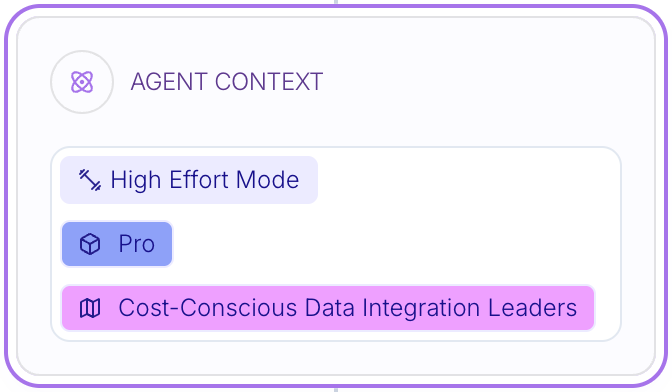
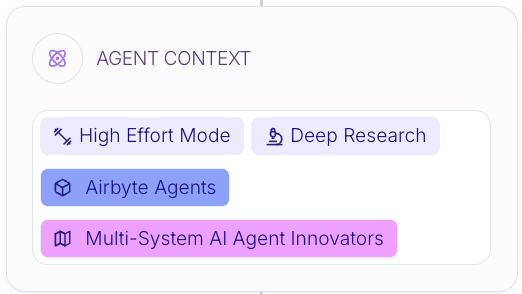
Octave also qualifies leads into 5-10 Playbooks with specific messaging tied to the relevant persona pains and Airbyte products.
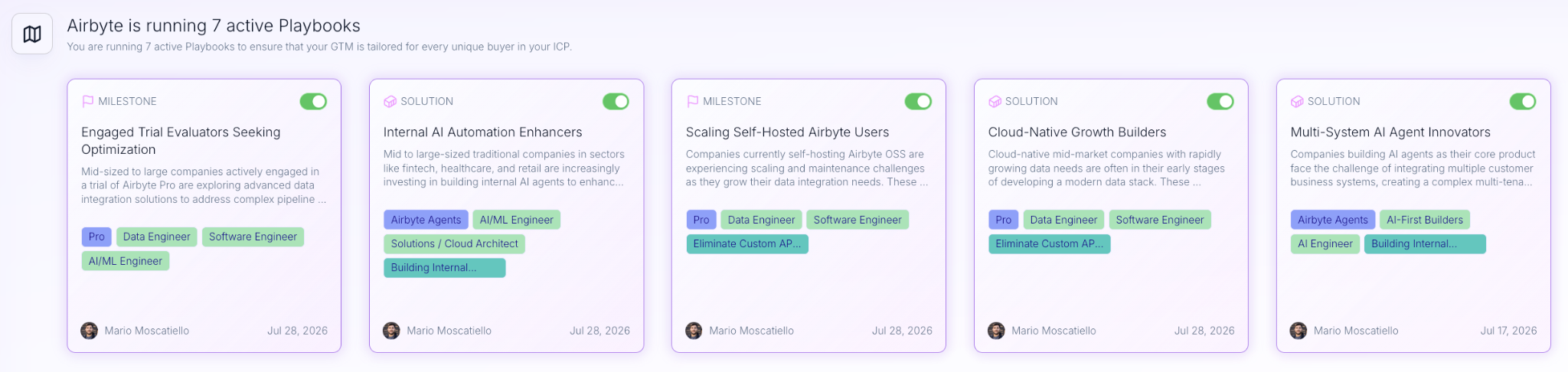
For example, an account can qualify into a Playbook oriented around an event trigger, such as:
- Large companies that are using an Airbyte Pro free trial and have completed their first successful sync.
- Self-hosted users that are scaling fast and would be a good candidate for a managed solution, assuming their business meets certain Qualifiers.
Other playbooks are oriented around sectors or business needs, such as:
- Companies building AI agents as their core products or internal workflows and therefore have an integration burden.
- Data infrastructure team leaders in regulated enterprises.
Like with persona and segment entities, Airbyte’s Playbooks also have a set of Qualifiers that a company needs to meet in order to receive that Playbook’s messaging.
BDR efficiency
Turning BDRs into superhumans
As a highly technical marketing leader, one of Mario’s missions at Airbyte was to turn the BDR organization into what he calls “superhumans.”
“Machines are really good at spotting patterns, telling you that certain copy will convert better for certain reasons. Humans are better at building relationships. When you combine the two, you get great results. The average BDR spends 50-60% of their time qualifying lists and crafting emails. Our mission at Airbyte was to bring that down to less than 20% of their time so they can spend 80% of their time meeting people. Octave is what really made that possible.”
“BDRs used to take hours to research midmarket and enterprise accounts, creating an account plan and making sure they’re targeting the right people. This has dropped to 30, 45 minutes with AI. With Octave, it’s virtually zero.”
Airbyte built a centralized system for BDRs where reps can wake up in the morning to see the top accounts they need to touch today, across inbound and outbound. Octave powers the qualification and selects the best messaging angles.
The emails are in their inbox, as well as cold call scripts with the 3 things they need to say personalized to a lead, so they can just open the dialer and start. Lower-scoring prospects receive automated sequences.
“Without Octave, we would have had to build an insane amount of infrastructure and stitch together 20 Clay tables just to get to the same level of work.”
This has greatly sped up the efficiency of the BDR team. “With our system and Octave, our team can now book double the pipeline of an average BDR organization,” says Mario.
In addition to this centralized outreach system, Airbyte’s BDRs needed scoring and personalization for one-offs. This was possible with the launch of Octave’s MCP in Claude.
“Octave started spreading within our organization when the MCP launched. Teammates can write a personalized sequence for someone they met at an event or qualify a hundred companies they found ad-hoc,” says Mario. “My BDR team is way more independent now, because we’ve taught the system to Octave.”
Personalization
Happier prospects, more relevant conversations
Airbyte had tried a range of AI-generated writing solutions that didn’t produce differentiated copy. Mario says, “We tried every agent researcher under the sun, from Clay agents built on ChatGPT and Claude to Common Room. But the copy looked the same, because they weren’t yet grounded in Airbyte company context — who we are, what we do, what our ICP is, and how we differentiate from competitors.”
The secret weapon in outbound, Mario says, is first-party data. “What integrations are they using with your product? What pages on your site did they visit? When we combine first-party context with Octave, we can infer someone’s use case and what really matters to them.”
“We've seen a 50% to 100% increase in pipeline per BDR since using Octave.”
Airbyte uses Octave in Clay to write call scripts and push email sequences to Instantly for campaigns. Airbyte’s Business Development Manager, Justin Bangay, also uses Octave context to quickly create personalized sales enablement and new hire onboarding materials.
“The relevancy of our emails have gone up, so our email reply rates have gone up,” says Mario. “When our reps are having conversations with prospects, prospects are genuinely happy about how relevant the conversation is. That’s why we have a super high pickup rate and conversion to meeting rate on the phone – because we’re talking about the right thing with Octave’s context.”
Current context
Messaging that updates itself via Suggestions and MCP
With the new AI product and a dev team shipping at lightning speed, Airbyte keeps its positioning up to date in Octave via intelligent suggestions and the Claude MCP.
Mario says, “If we launch a new feature, I can easily tell the MCP in Claude to update our Octave library, playbooks, and agents to reflect our latest product features. Octave is amazing at editing copy at scale. I had a Claude session open to refine the positioning of our new product, and could just rewrite sections in Octave using the context.”
“The beauty of Octave is how easy it is to update. When we refined our new product positioning, we were able to revamp our playbooks and product entity in 15 minutes.”
Octave also auto-suggests updates to the library based on its realtime analysis of customer calls. It learns from Gong call transcripts to understand what prospects and customers are talking about — competitors that keep coming up, pains certain personas are facing, and value props that land with one segment but not another.
When Octave sees a strong enough pattern, it suggests an update for the team to accept into the canonical messaging. In one two-week stretch, more than 20 of Airbyte’s conversations included the same complaint about competitor Fivetran: its usage-based pricing gets unpredictable and expensive at scale.
Octave turned that pattern into a new line in the Fivetran competitive entity about Airbyte’s predictable pricing. Agents and reps could use the new messaging right away, without waiting for an enablement session.
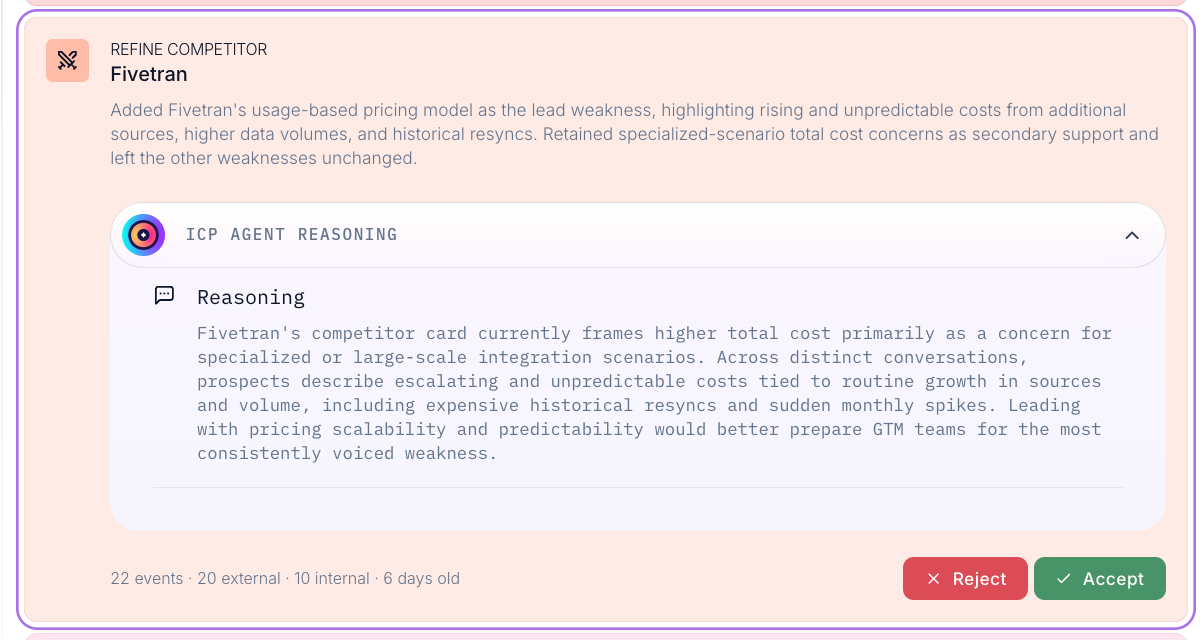
The team can click into the suggestion to see which companies and people voiced this concern, on which dates — or go straight to the transcript source.
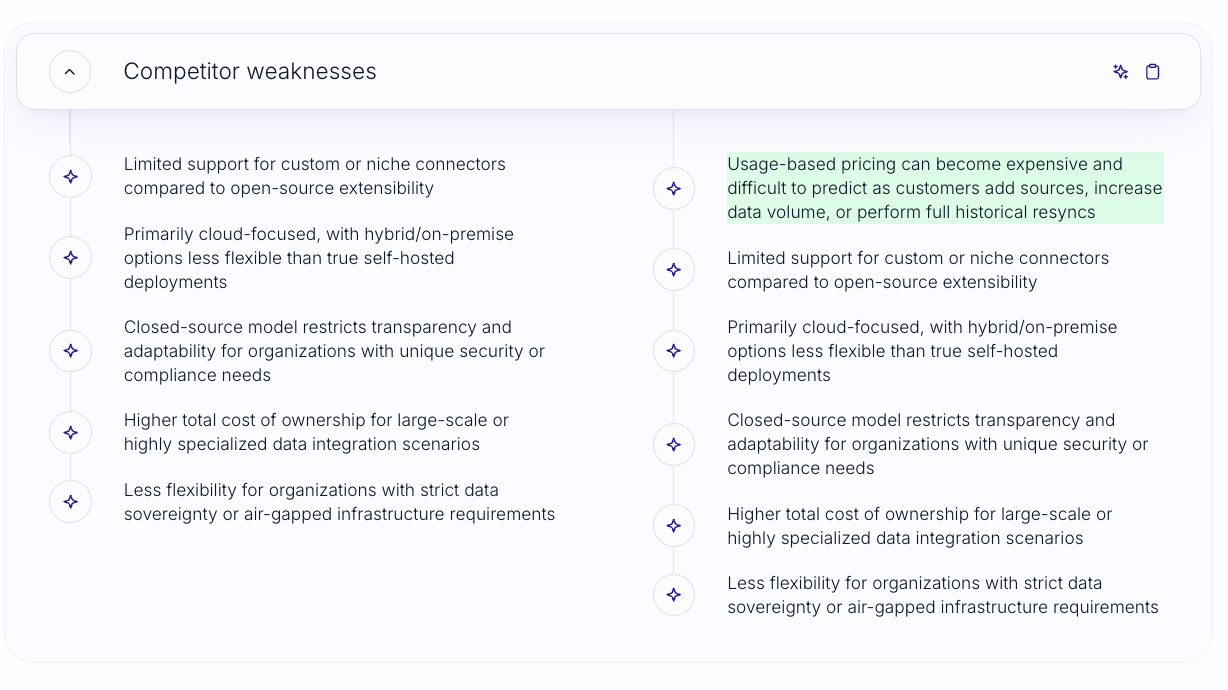
"With Octave, we’re able to discover and act on new value propositions much faster,” says Mario.
Data warehouse sync
Call intelligence, queryable in Airbyte’s data warehouse
Airbyte owns all its data and intelligence from Octave because it’s synced back to BigQuery. This lets business users across leadership, marketing, product, and sales better understand how Airbyte is landing with prospects and customers.
“We like that Octave is an open system instead of a black box, letting us own all the ingredients to better analyze our conversations with our prospects and customers.”
Hundreds of out-of-the-box extractors spot new objections, competitor differentiation opportunities, and possible features for its new product. Teammates can also easily add new things they want Octave to learn.
This lets them answer increasingly complex questions about what is driving their buyers to engage and convert. If Airbyte wants to know, “What coding languages do our customers use?” Octave finds the answers across past and future calls.
Airbyte's story has always been about moving data to wherever it creates value — first for analytics, now for AI. Its go-to-market runs on the same principle. By making its messaging, ICPs, and competitive knowledge a living system in Octave rather than static documents, Airbyte turned institutional knowledge into something every tool, agent, and teammate can act on.
That's what let a company with 7,000+ customers and a thriving open-source community launch into an entirely new market at startup speed — and it's the same playbook Airbyte will run for whatever comes next.
