
Every decision is critical. Back it with better intelligence.
Octave connects buyer conversations, deal activity, and market shifts to a deep understanding of your GTM. It uncovers what matters before you know what to ask, so you can sharpen your message, focus your targeting, and move deals forward.
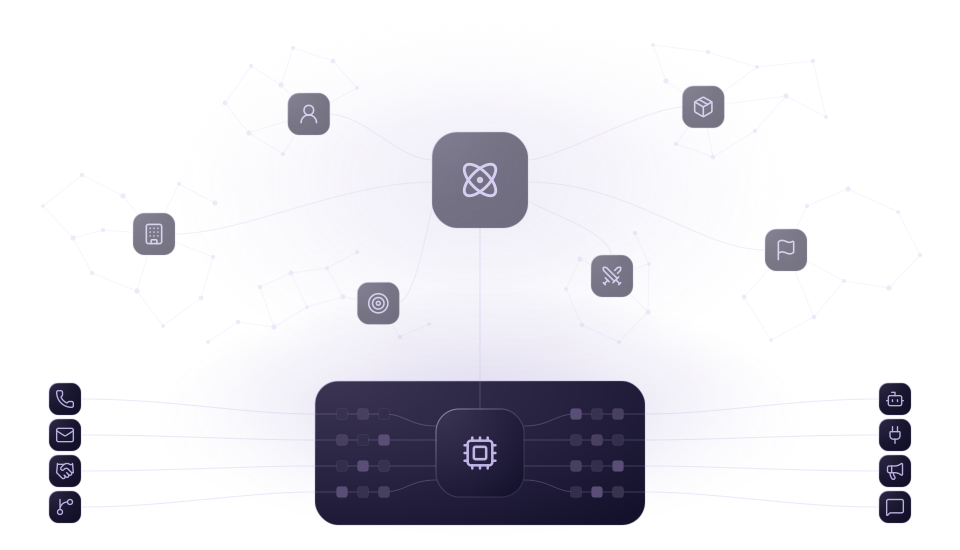
How it works:
Octave observes buyer interactions and market trends through your context graph. This dynamic between ontology and observation gives every finding more meaning than typical filters and trackers.
01
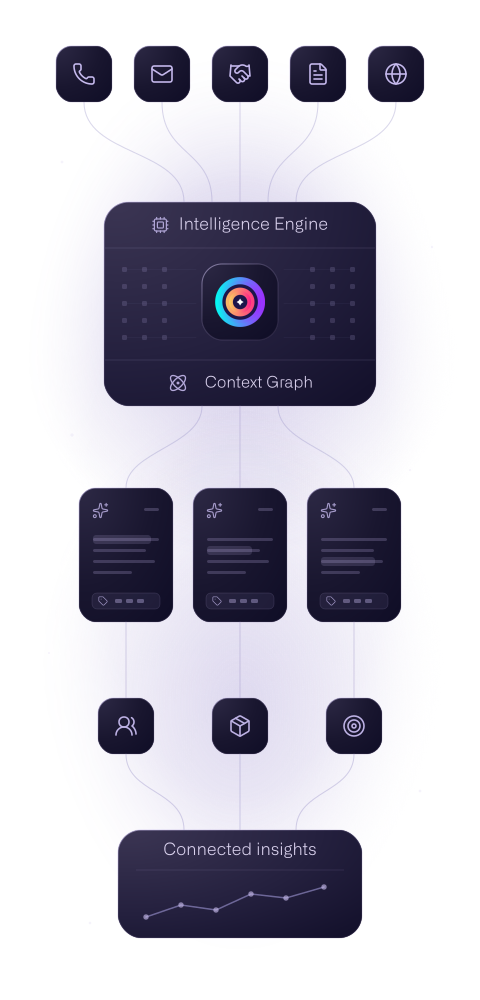
Connections: Octave observes your evidence
Connect your call recorder, CRM, email tools, and other platforms to Octave. This data provides buyer interactions for Octave to learn from in real time. Native integrations, API, webhooks, and data warehouse sync expand the types of data to observe.
02
Interpretation: Identify who’s speaking and what’s being sold
When Octave looks at a call, email, or deal progression, its first task is to determine whether a conversation concerns a net-new purchase, an expansion, or something else. Then it maps the interaction to the relevant entities in your context graph, like personas, segments, products and features discussed, buying triggers mentioned, objections that came up, and more. It’s like a rep who diligently tags every call.
03
Annotation: Label findings with the meaning behind the words
Next, Octave uses 150+ out-of-the-box extractors to search for common GTM topics being discussed. (And custom extractors let you answer questions specific to your business.)
Octave breaks down a conversation into snippets, labeling relevant concepts for each micro-moment of the conversation, such as:
- pains being experienced
- concerns being addressed
- capabilities being offered
- outcomes being desired
- and more
This links a buyer’s expressions in a conversation to entities in your graph. And if you change an entity in your context graph, Octave reannotates past conversations to include that change.
04
Insights: See patterns you didn’t know to look for
Multi-hop reasoning lets Octave piece together findings that traverse your context graph. This helps you understand where you win deals, and how to apply successful strategies again.
For example: Do CMOs at financial services companies who describe a particular pain tend to share a common objection? Which reframes and responses do our reps use, and which work best?
These insights come to life across win/loss analysis, ICP insights, competitive intelligence, customer voice reports, and more. They help you understand your buyers not just by their firmographic attributes, but by their qualitative pains, goals, business constraints, and more.
05
Learning loops: Continuously refine your GTM strategy
Octave suggests improvements to your context graph when it detects a gap, using significance thresholds to filter isolated feedback from real patterns. This is how your team stays on top of new competitors, changing buyer objections, and the latest language that moves deals forward.
06
Market intel: See external trends through your strategy
Octave also monitors competitor news, market trends, and trends in your customers’ markets. For example, when a competitor launches a new capability, Octave can add it to the competitor’s entity in your graph, with the recommended counterpositioning based on your product’s features.
Intelligence you can inspect, own, and trust.

Inspectable
See the evidence and reasoning behind every finding, all the way back to the source.

Open
You own your findings and the configuration. All data is syncable and exportable, anytime.

Versioned
Trace and audit changes to your context graph, with built-in versioning.
Go-to-market is a system.
Treat it like one.
