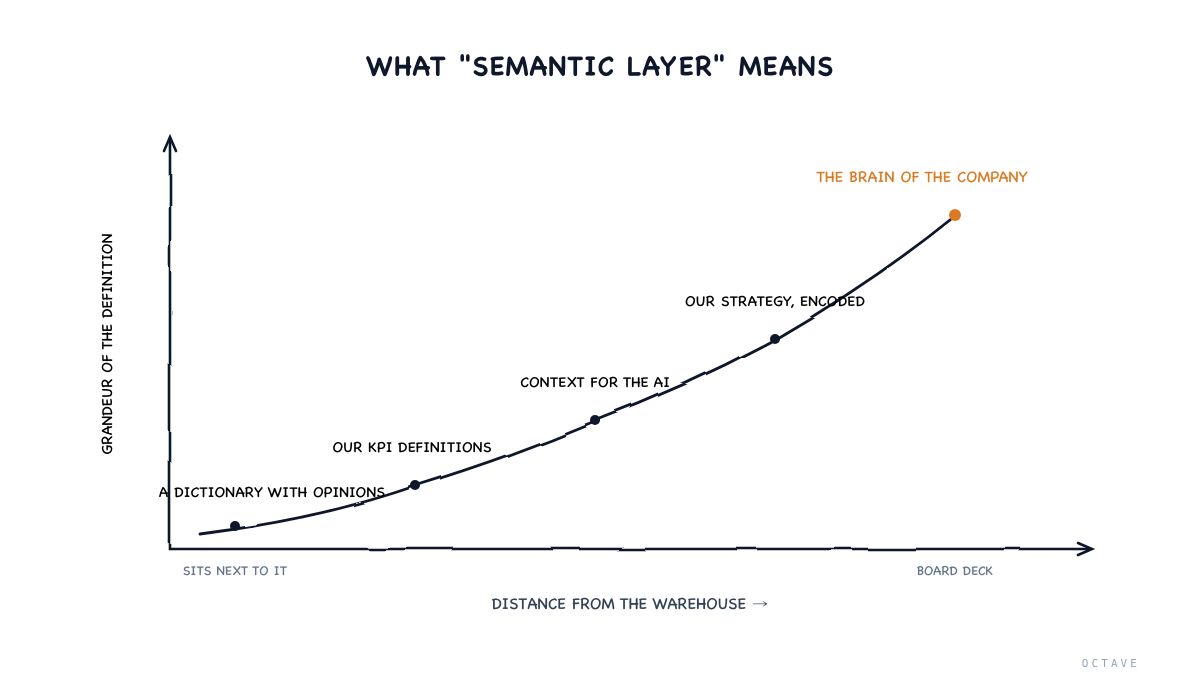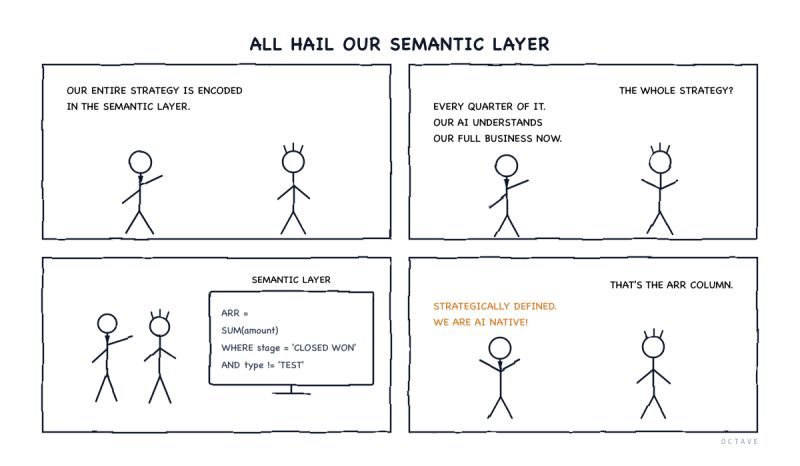
You can watch the definition drift with distance from the warehouse. The team building it will tell you plainly what it is. Canonical definitions of tables and columns. Which fields to trust and which to never touch. The joins and filters that turn raw events into the official revenue number instead of one of the six unofficial ones. A dictionary, with opinions. If an agent is going to touch your warehouse, this is the difference between it reporting the number and inventing a number. Skip it and every AI answer that cites your own data is a coin flip.
Three floors up, "we're building our semantic layer in Snowflake" has become "we're teaching the AI what our business means." Meaning. Context. Strategy. The brain.
But look at what it covers. Structured data. Rows and columns. A semantic layer can tell an agent that win rate means closed-won over all closed, disqualified deals excluded, opportunity table and nowhere else. It cannot tell the agent why win rate dropped. That answer is sitting in call transcripts, email threads, and lost-deal notes, and no column dictionary reaches any of it.
Unstructured data needs its own layer, and it's a different kind of work. Not field definitions but entities, relationships, and beliefs. Who you sell to, what wins, which competitor keeps showing up, what should count as a top objection. Mapping tells you what the data is. Judgment tells you what it means for the next decision. The best GTM teams are doing both.